The Future Accounting Department
I have a client with $25 million in sales and $5 million in EBITDA. For a manufacturer, those numbers tend to attract attention from potential buyers. And this year, that’s exactly what happened — we found ourselves in the middle of a due diligence process for a potential transaction.
The process went smoothly throughout. In fact, our investment banker remarked that in 25 years, he had never seen a group so responsive to information requests. There was, however, one thing the potential buyer couldn’t get past: for a company this size, how were they operating with no full-time accounting staff?
It baffled them throughout the entire process. They were accustomed to an organization this size having a controller, a bookkeeper, and likely additional support staff — an accounting and finance function that typically carries a price tag of $300,000 or more.
So how was this company running its entire accounting department for less than $100,000 — and arguably getting the same or better results?
The Accounting Department Setup
When I first started with this company several years ago, it looked like a typical organization of its size. Revenues were just above $8 million, and they had a controller in place earning $130,000 a year.
The owner wasn’t satisfied — not with the quality of the accounting, and not with the insights he was getting into his own results. That’s what brought me in as an outsourced CFO.
His instincts were right. The controller wasn’t cutting it, and getting to accurate numbers was going to require a change. Over the next five months, we cycled through two additional controllers — each one more expensive than the last.
Around that same time, I had started exploring the idea of hiring a bookkeeping resource in the Philippines for my own practice. I’d spoken with colleagues who had gone that route, and most had very positive things to say. I won’t pretend the cost difference wasn’t a factor — hiring a comparable resource in the Philippines typically runs about 75% less than hiring one in the United States.
I brought the idea to the owner, and to his credit, he jumped on it immediately. Within a week, we had interviews scheduled with three firms in the Philippines to help us find the right person.
That was three years ago. Today, we have two Philippines-based resources embedded in the accounting function. One operates in an Accounting Manager capacity; the other handles AR and AP. Both have been exceptional, and the quality of their work has been nothing short of outstanding.
Preparing for Outsourced Employees
I’ve spoken with business owners who have gone down a similar path and not had the same results. When I dig into why, the answer is almost always the same — they approached hiring an outsourced resource the same way they would any other employee. That’s where it breaks down.
The key to making an overseas accounting resource work is having strictly documented processes before they start. When we began, we outlined seven or eight core processes — how we invoice customers, how we receive and apply payments, how we follow up on outstanding balances, how to input vendor invoices, and a handful of others. Each process had both a written SOP and a walkthrough video.
The onboarding went better than I expected. Our first Philippines resource picked things up quickly, and as she got comfortable with the initial processes, we layered in more. She eventually got so good at her role that we had her lead the hiring process for the AP/AR clerk position.
The Accounting Department of the Future
The Impact of AI
The full impact of AI on accounting and finance is still playing out. We are still a few years away from seeing the complete impact. What isn’t in question is that the impact will be significant.
Larger companies — those over $50 million in revenue — have the resources to dedicate teams to automation and AI strategy. The smaller companies I work with have to take a different approach.
AI Limitations
Before we talk about how AI will be used, let’s acknowledge the current limitations.
Almost all of my clients use QuickBooks Online — only two don’t. To say QBO’s use of AI is lacking would be too kind to Intuit. There are two fundamental problems with relying on QBO to lead small businesses into an AI-driven accounting function:
- QBO was never built for AI. QuickBooks has been around since 1992, and QBO since the early 2000s. Both were introduced at a time when AI was still a thought experiment. It’s legacy software, and it shows. Its code, database, and underlying technology was never built for AI. While they can attempt to have it adapt, it will struggle to catch up to AI-first developed solutions.
- QBO was never built for your specific business. Ever wonder why QBO has such a large marketplace of third-party vendors? Because accounting practices vary widely across industries and business models. QBO has done a solid job building a functional general ledger system — but when it comes to the specific way your business operates, it falls short.
So the question becomes: how is QBO going to build meaningful AI solutions for businesses this diverse? They’ll try. But it will fall short.
You might be thinking — what about those AI tools that let you upload invoices directly into QBO? Fair point. But those solutions have been around for nearly 20 years. Innovative accounting departments are already using them. Using AI to automate transaction coding – machine learning has been doing that for years. That’s not the future; that’s the present.
How AI Will Be Used
With things like Claude Cowork and Claude Code now becoming easier to use then ever, small businesses will be able to build custom solutions to fit their specific needs.
Today, it’s estimated that fewer than 5% of the general population has used AI to write code. When you take into account that 96.2% of developers admitted to using it to code, it means there is only a small share of the general population that uses AI to code.
That’s about to change — and financial professionals are going to be at the center of it.
Custom solutions built by people with financial expertise are the future of AI in accounting. Yes, AI can help interpret financial data. But you need to know the right questions to ask, and you need to understand the context behind the answers. That financial judgment doesn’t go away — it becomes more valuable.
What changes is that financial expertise will need to be paired with a new skill: the ability to build small, custom applications designed around how a specific business actually works.
AI In Action
Consider a mid-sized landscaping company with 12 employees and a mix of residential maintenance contracts and one-off commercial jobs. The owner knows cash gets tight every March and October, but has never been able to pinpoint exactly why — or see it coming early enough to do anything about it. Her bookkeeper keeps the books clean in QuickBooks, but nobody on the team has the financial background to translate that data into a forward-looking cash picture.
Her fractional CFO, armed with tools like Claude Code and Cowork, builds her a simple custom application in a matter of hours. It pulls her QuickBooks data, maps out when invoices are likely to be paid based on each customer’s historical patterns, overlays her known upcoming expenses — payroll, equipment leases, supplier bills — and produces a rolling 13-week cash forecast she can check every Monday morning. No spreadsheet to maintain, no manual data entry. Just a clean view of what’s coming.
The CFO didn’t write that app because they are a software developer. They wrote it because they understood the cash flow problem deeply enough to know exactly what the tool needed to do — and AI handled the rest.
Putting It All Together
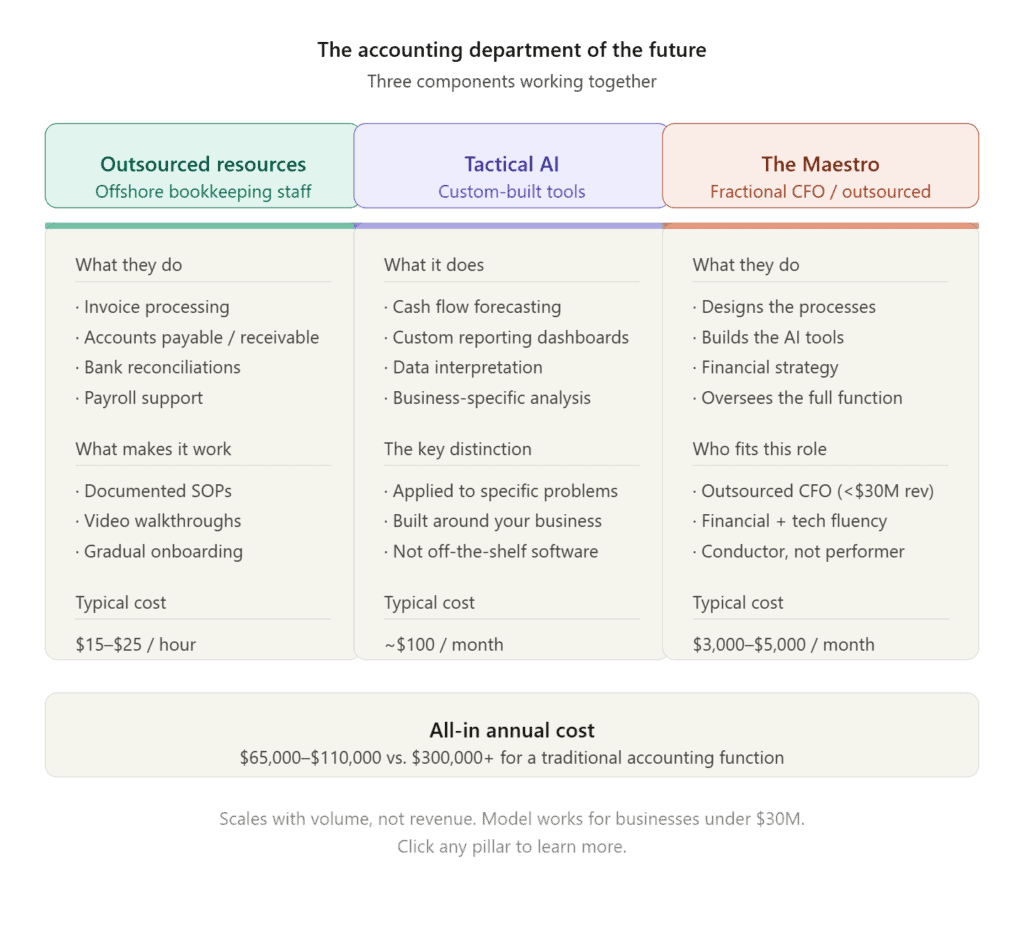
So what does this accounting department of the future actually look like? Three pieces working together:
- Outsourced resources. These team members provide the same value as a traditional bookkeeper, but at a fraction of the cost. Manual input and routine tasks still exist — but with the right processes in place, handling them no longer requires a significant financial commitment.
- Tactical AI. Artificial intelligence works best when it’s applied to specific, well-defined business problems. The goal isn’t AI for the sake of AI — it’s identifying the right use cases and building custom tools to address them.
- A Maestro. At the top of the function sits someone who can conduct all of it. That means designing the processes that keep the manual work running smoothly, building the custom AI solutions the business needs, and bringing financial expertise and strategic thinking to the organization as a whole. For businesses under $25–$30 million in revenue, this is often an outsourced role.
Scaling an Accounting Department
A quick note on the relationship between revenue and accounting costs — because it’s not what most people expect.
We tend to think about scaling businesses in terms of revenue. But accounting departments don’t scale with revenue — they scale with volume.
The manufacturer from the opening of this article processes 20–25 customer invoices per week and 35–45 vendor invoices. Payroll covers 50–60 employees. I have another client doing the same revenue who issues 16,000 customer invoices per month. Those two businesses require very different accounting functions, even though their top lines look identical. Figuring out the right staffing model for your specific volume is exactly the kind of thing the Maestro should be helping you with.
For businesses under $10 million in revenue, the model doesn’t change — only the scale of the resources within it. Maybe the manual accounting doesn’t require a full-time person. Maybe it’s someone working five to ten hours a week. The structure still holds.
A Cost Comparison
The good news for business owners is that this new model costs significantly less. An outsourced controller typically costs $3000 – $5000 per month. A resource in the Philippines is typically $15-$25/hour. An AI software, as of right now, typically runs $100/month.
Add all this together, and full a business that requires a full time accounting resource, the costs is between $65,000 and $110,000 per month.
What to Do Next?
The accounting department of the future isn’t coming — it’s already here. The businesses that figure this out early will carry a significant cost advantage over those that don’t, and that advantage compounds over time.
If you’re a small business owner, the takeaway is simple: you don’t need a $300,000 accounting function to get $300,000 worth of results. What you need is the right model — outsourced resources with documented processes, AI applied to the specific problems your business faces, and a Maestro who can tie it all together.
The question isn’t whether this model works. I’ve watched it work firsthand, through a due diligence process that left a seasoned investment banker scratching his head at the level of success we had without the associated cost.
The question is whether you’re willing to rethink what an accounting department is supposed to look like — and take advantage of it before your competitors do.