Why Most Small Business Owners Still Don’t Have a Succession Plan — and What That Means for the Future
Quick answer: most small business owners don’t have a succession plan — and the real risk isn’t retirement, it’s value. Without a plan, the business you built can lose a large share of its worth the moment you step back, get sick, or field an offer. A succession plan protects that value long before you need it. (Related: how to buy or sell a business.)
Most small business owners spend years obsessing over growth, margins, hiring, and customer retention. Very few spend the same amount of time thinking about how — or when — they will eventually step away.
That blind spot is no longer anecdotal. A recent Gallup poll sheds light on a quiet but serious issue facing the small business economy: the majority of owners do not have a succession plan, even as many approach retirement age.
According to Gallup’s nationally representative survey of U.S. small business owners, more than half are 55 or older, yet only a minority have a clear plan for what will happen to their business when they leave. You can read the full findings in Gallup’s report, “Most Small-Business Owners Lack a Succession Plan”, published in March 2025 (Gallup).
This is not just a personal planning issue. It’s a financial, operational, and economic risk — one that affects employees, customers, families, and communities.
What the Gallup Poll Actually Found — and Why It Matters
Gallup’s research paints a picture that many advisors see firsthand but rarely quantify. Among small business owners:
- A significant share expect to close their business outright when they retire rather than sell or transfer it
- Many report that they haven’t decided what they will do with the business at all
- Only a small portion have identified a successor or structured transition plan (Gallup)
In other words, decades of value creation are at risk of simply disappearing.
External research reinforces this point. A national study on owner decision-making around succession found that most owners delay planning until the final years before exit — often too late to preserve value or ensure continuity (ideas42).
From a financial perspective, this is alarming. A business without a transition plan is harder to value, harder to finance, and harder to sell — regardless of how profitable it may be today.
Succession Planning Is Not a Retirement Problem — It’s a Value Problem
Many owners mentally file succession planning under “retirement issues,” assuming it can wait. That framing is dangerous.
Succession planning is fundamentally about protecting enterprise value.
A business with:
- Documented systems
- Transferable leadership
- Predictable cash flow
- Clear governance
is worth materially more than one dependent on a single individual.
This is why buyers, lenders, and investors consistently discount businesses that lack leadership continuity. Even internal successors — family members or key employees — struggle when there is no defined roadmap.
This dynamic shows up clearly when owners attempt to sell. As outlined in What Does a CFO Really Do?, most exits fail not because the business isn’t profitable, but because it isn’t prepared to operate without the founder.
The Hidden Costs of Ignoring Succession
Failing to plan doesn’t preserve flexibility — it destroys it.
Forced Exits
Health issues, burnout, or market shifts can force owners into rushed decisions. Without preparation, these exits are almost always value-destructive.
Loss of Institutional Knowledge
Operational knowledge, customer relationships, and vendor leverage often live entirely in the owner’s head. When that knowledge leaves abruptly, performance follows.
Business Closure Instead of Transfer
Gallup’s finding that many owners expect to simply close their business is especially troubling. Closures eliminate jobs, disrupt customers, and erase equity that could otherwise fund retirement or future investments.
Data on leadership transitions shows that companies with proactive succession planning outperform peers over time, while those without it experience instability and revenue decline (Keevee).
Why Owners Delay — Even When They Know Better
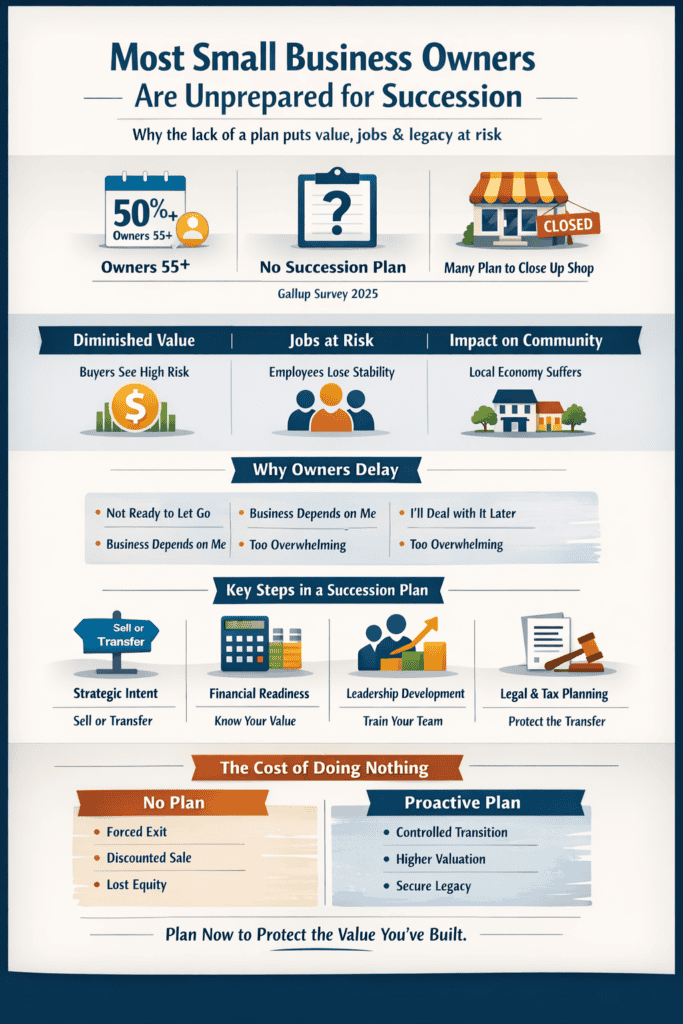
Succession planning is rarely delayed because owners don’t understand the logic. It’s delayed because of human factors.
- Identity is tied to the business
- Control is difficult to relinquish
- Family dynamics complicate decisions
- The process feels overwhelming
Ironically, the longer an owner waits, the fewer good options remain. This is particularly true in closely held and family-owned businesses, where emotional considerations can stall rational planning (ADP).
What a Thoughtful Succession Plan Actually Includes
Succession planning does not require certainty — it requires structure.
At a minimum, a strong plan addresses four areas:
1. Strategic Intent
Does the owner want to sell, transfer internally, or gradually step back? Each path demands different preparation.
2. Financial Readiness
Understanding normalized earnings, cash flow durability, and valuation drivers is essential. Buyers don’t pay for potential — they pay for predictability.
3. Leadership Development
Internal successors need time, authority, and accountability well before transition.
4. Legal and Tax Alignment
Ownership transfers, estate planning, and tax strategy must align with the business plan, not operate in isolation.
A well-structured approach mirrors the same discipline used in financial forecasting and growth planning. As discussed in Actionable Financial Statements, clarity in reporting and decision-making today determines optionality tomorrow.
Succession Planning Is Part of Financial Strategy — Not Separate From It
Too often, succession is treated as a legal exercise. In reality, it’s a financial strategy decision.
Cash flow stability, margin discipline, leadership redundancy, and documented systems all increase both day-to-day resilience and exit value. These are the same fundamentals that make a business easier to finance, easier to grow, and easier to step away from when the time comes.
Owners who integrate succession into their broader financial planning retain control longer — not less.
The Broader Economic Impact No One Talks About
Small businesses are major employers and community anchors. When owners exit without plans, the consequences extend well beyond the individual.
Closures reduce local employment, weaken supply chains, and eliminate services that may not be easily replaced. At scale, weak succession planning becomes a macroeconomic problem, not just a personal one.
Gallup’s data should be read as an early warning, not a curiosity.
A Strategic Outlook for Owners
Succession planning is not about giving up control. It’s about earning the right to step away on your own terms.
The most successful owners approach it the same way they approached growth:
- Early
- Intentionally
- With the right advisors
The businesses that survive leadership transitions — and often thrive afterward — are rarely the most charismatic or the most complex. They are the ones built to operate independently of any single person.
The question is no longer whether succession planning matters. Gallup has already answered that.
The real question is whether owners will treat it with the same seriousness they apply to revenue, cash flow, and strategy — before the window to do so closes.