
Outsourced CFO for Consulting Firms: Why Financial Strategy Is the Missing Growth Lever

Consulting firms rarely struggle because they lack expertise. More often, they struggle because the business beneath that expertise never fully matures. Client demand exists. Teams stay busy. Revenue grows. Yet cash remains tight, margins fluctuate, and the owner feels more pressure with each passing year instead of more control.
This isn’t a talent problem. It’s a financial leadership problem.
An outsourced CFO is not about producing cleaner financial statements. It’s about installing financial strategy that allows a consulting firm to scale deliberately, price confidently, and grow without increasing chaos. For professional services firms that want predictability and leverage, finance must function as an operating system—not a reporting function.
The Unique Financial Reality of Consulting Firms
Consulting firms operate under a fundamentally different economic model than product-based businesses. There is no inventory to optimize and no manufacturing process to scale. The primary asset walks out the door every night. Revenue is driven by people, utilization, and pricing discipline.
This creates fragility. Payroll often runs 50–70% of revenue in professional services. Small changes in utilization, scope control, or pricing can materially impact profitability, often without obvious warning signs in a standard income statement. Owners frequently confuse full calendars with financial health.
David Maister addressed this head-on in Managing the Professional Service Firm, where he outlined how utilization, leverage, and pricing—not volume—determine success in service businesses
https://www.amazon.com/Managing-Professional-Service-David-Maister/dp/0684834316
The implication is critical: consulting firms cannot be run effectively with generic accounting oversight. They require financial leadership that understands how service economics behave as complexity increases.
Revenue Growth Without Financial Structure Is a Trap
Many consulting firms don’t fail — they stall. Revenue increases, but margins compress. Headcount grows, but cash tightens. The firm becomes dependent on constant selling just to stay even.
This happens when growth amplifies weak structure. Underpriced engagements are repeated. Scope creep becomes normalized. Hiring decisions are made reactively instead of strategically. The firm grows in size but not in strength.
An outsourced CFO introduces discipline where it matters most. Financial analysis forces clarity around which services, clients, and delivery models actually create value. Growth stops being measured solely by top-line revenue and starts being evaluated through contribution margin, capacity utilization, and cash timing.
If growth is making the business harder to manage, demand isn’t the problem. Structure is.
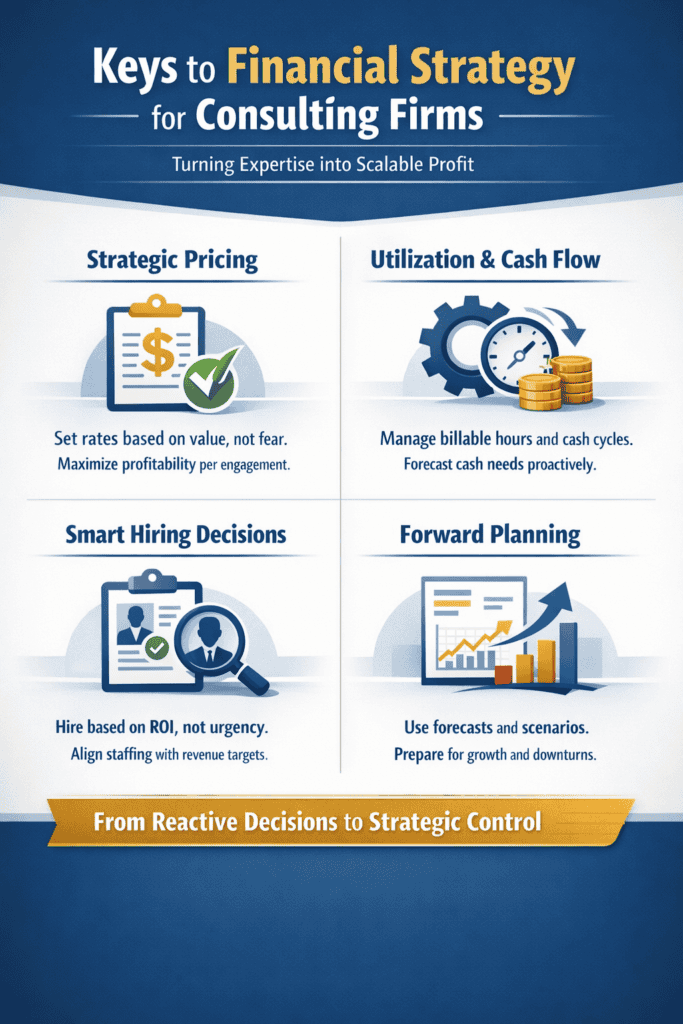
Pricing Discipline Is a Financial Strategy, Not a Sales Tactic
Consulting firms routinely underprice their work. Discounting becomes habitual. Fees are set based on precedent rather than economics. Scope expands while price remains fixed.
The math is unforgiving. In a labor-driven business, a 10% pricing error can erase 30–50% of profit once fully loaded labor costs are considered. Most firms never calculate this explicitly, which allows margin erosion to continue quietly.
A CFO reframes pricing as a strategic decision. By analyzing profitability by service line and engagement type, pricing becomes intentional. The conversation shifts from “What will the client pay?” to “What does this work need to earn to justify the resources it consumes?”
This is often one of the fastest ways consulting firms improve profitability without adding new clients. Strong pricing discipline also becomes the foundation for more accurate forecasting and planning, which turns historical financials into actionable tools rather than backward-looking reports
https://k-analytics.com/actionable-financial-statements/
Utilization Is the Engine, Cash Flow Is the Fuel
Utilization drives revenue, but cash flow determines survival. Many consulting firms track billable hours informally, if at all. Even fewer connect utilization data to hiring plans, pricing strategy, and cash forecasting.
At the same time, service businesses are structurally exposed to cash volatility. Delayed billing, approval cycles, retainers that don’t align with delivery, and uneven project schedules all create gaps between work performed and cash collected. Owners often bridge those gaps personally without recognizing the long-term risk.
The SBA consistently identifies cash flow mismanagement as a leading cause of small business distress — even among firms with strong demand and growing revenue
https://www.sba.gov/business-guide/manage-your-business/manage-your-finances
An outsourced CFO connects utilization, billing practices, and cash forecasting into a single system. Hiring decisions align with revenue timing. Cash pressure is identified months in advance instead of weeks too late. Owners regain visibility and control.
For many firms, improved cash flow management provides immediate operational relief while enabling better long-term decisions
https://k-analytics.com/power-of-cash-flow-management-small-business/
Hiring Decisions Should Be Financial Decisions
In consulting firms, hiring is the largest recurring investment decision. Yet it’s often driven by urgency rather than economics. The team feels stretched, so a hire is made. Pricing doesn’t change. Utilization assumptions remain optimistic.
A CFO introduces rigor into hiring decisions. What utilization rate is required for this role to break even? How long should ramp-up take? What pricing assumptions must hold true? What happens if demand softens?
This level of analysis doesn’t slow hiring — it improves it. Firms stop hiring junior staff to compensate for weak pricing. They stop overpaying senior talent without a leverage plan. Capacity planning becomes intentional instead of reactive.
Why Most Consulting Firms Outgrow Their Bookkeeper
Bookkeeping explains what happened. Consulting firm owners eventually need guidance on what should happen next. This is where many firms feel stuck. The numbers are accurate, but they don’t drive decisions.
An outsourced CFO translates financial data into operating insight. Reporting evolves from static P&Ls into tools that highlight service-line profitability, utilization efficiency, and forward-looking scenarios. Forecasting becomes practical instead of theoretical.
Firms that actively use forecasting tend to be more resilient during downturns and more decisive during growth periods. Financial clarity reduces reactionary decision-making and gives owners confidence.
The Real Value of an Outsourced CFO for Consulting Firms
The idea that CFOs are only for large companies misses the reality of professional services. Consulting firms experience complexity long before they experience scale.
An outsourced CFO provides:
- Strategic oversight without full-time cost
- Objective guidance on pricing, hiring, and growth
- Financial systems that scale with the firm
- A buffer between ownership and reactive decisions
Most importantly, a CFO helps the owner move out of survival mode. Decisions become proactive. Trade-offs become explicit. The firm becomes something that can operate without constant intervention.
Financial Strategy Creates Optionality
The ultimate objective isn’t just higher profit. It’s optionality.
Well-run consulting firms have choices. They can grow deliberately. They can stabilize and optimize. And lastly, they can pursue acquisitions, bring on partners, or step back operationally. Poorly structured firms don’t have those options — they are trapped by momentum.
An outsourced CFO builds the financial foundation that creates those choices. Systems replace heroics. Strategy replaces reaction. The business stops depending on the owner’s constant presence to function.
Strategic Outlook: From Expertise to Enterprise
Consulting firms are built on expertise, but they scale on discipline. The difference between a lifestyle practice and a durable enterprise is rarely talent. It’s financial structure.
An outsourced CFO doesn’t replace the owner’s vision. It sharpens it. It provides the framework to make better decisions faster — and to build a consulting firm that grows with intention instead of inertia.